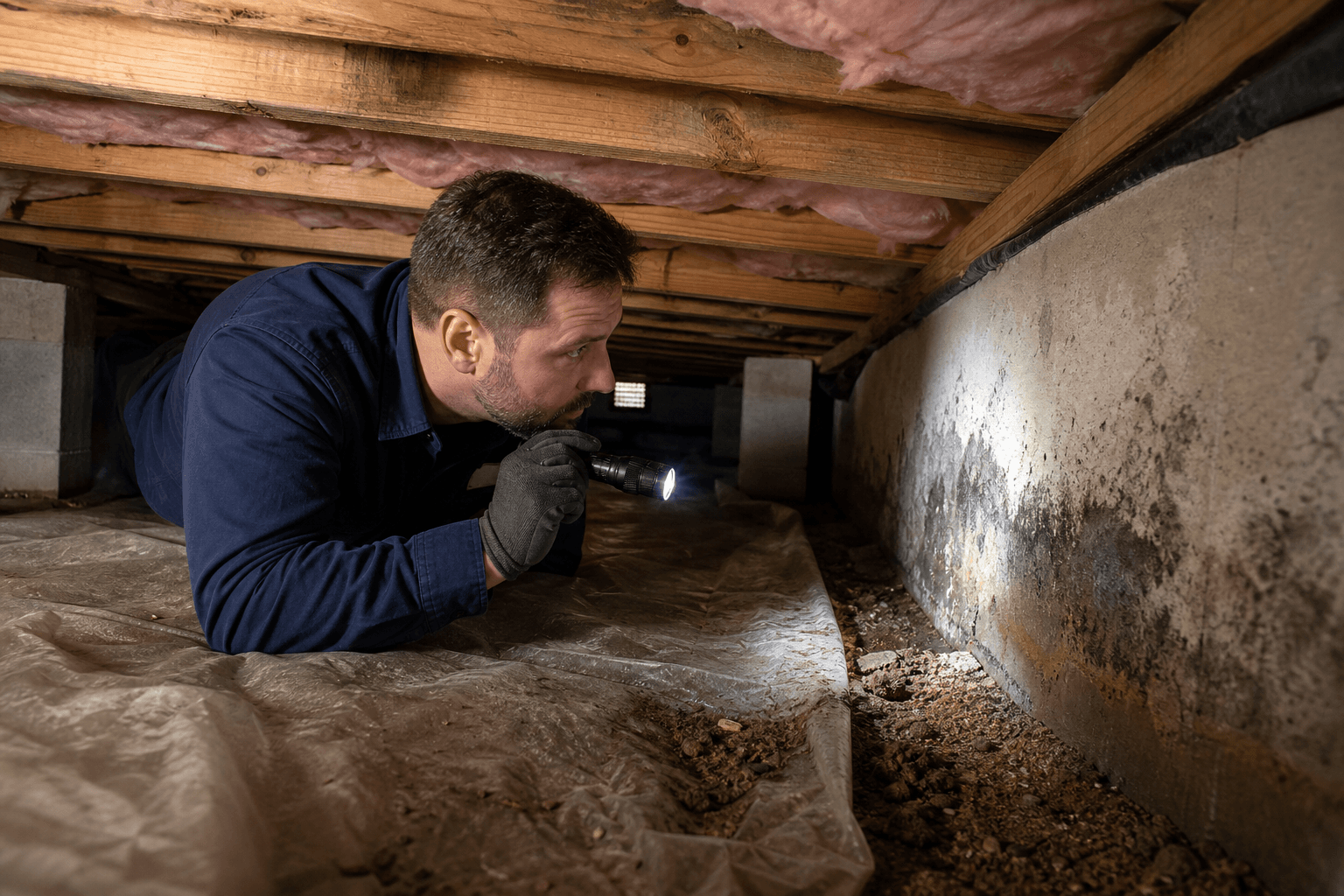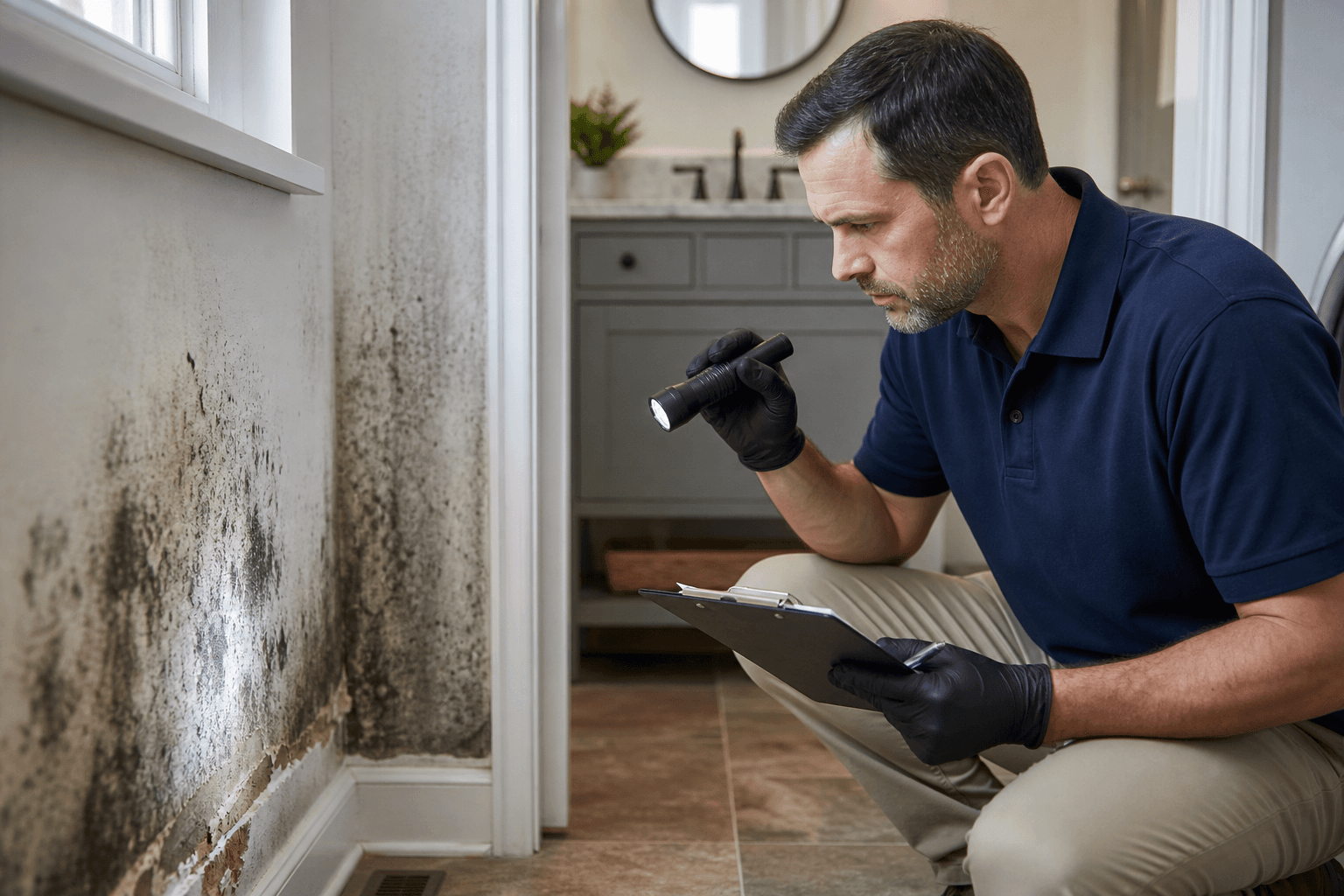
The 7-step decision checklist
This checklist maps Canadian guidance to practical on-site checks you can do before contacting a professional mould inspection service. Use these seven steps to decide whether the problem is manageable with household measures or whether you should schedule a certified inspection. The federal Health Canada guidance provides an area-based approach to decide when to seek professional help, and CMHC and NCCEH resources offer practical inspection and sampling guidance you can follow while you walk the property (Canada.ca guidance, CMHC mould in housing, NCCEH toolkit).
1. Visible mould, discoloured surfaces, or a persistent musty odour
Inspect walls, ceilings, baseboards, window frames and areas behind furniture. If you see mould patches or widespread staining, estimate the affected area. Canada.ca uses size thresholds to guide whether professional assistance is needed; small isolated spots may be cleaned by occupiers while larger or recurring growth should prompt a professional assessment (Canada.ca guidance). University extension checklists also show that a musty odour is a strong indicator of hidden moisture or mould and should not be ignored (home inspection checklist).
2. Recurring moisture or leaks in the same location
Look for water stains, peeling paint, bubbled vinyl, soft drywall, or repeated patch repairs. Recurring dampness means the source has not been fixed and mould will likely return. CMHC advises that repeated leaks or moisture events require investigation of the source and often a professional inspection to find hidden entry points or failures in building systems (CMHC mould in housing). The practical home checklist also recommends recording the pattern and timing of wetting to help a specialist diagnose the cause (field guide).
3. Water damage near structural elements or inside assemblies
If staining or dampness is adjacent to load bearing walls, roof assemblies, floor joists, or inside wall cavities, treat the issue as higher risk. Mould inside assemblies can remain hidden and spread before visible signs appear. Canada.ca specifically signals that mould inside structural components usually requires professional assessment and a repair plan to address both moisture and damaged materials (Canada.ca guidance). When structural elements are involved, do not cut, pry, or remove materials without a plan for containment and documentation.
4. Chronic damp basements, crawlspaces or attic condensation
Basements and crawlspaces are common sources of long term humidity and mould, often caused by poor grading, clogged gutters, missing drain tiles, or inadequate ventilation. Attic condensation points to ventilation or insulation issues and can cause widespread mould in roof assemblies. Field guides and Canada.ca recommend elevating chronic moisture problems to a professional who can diagnose drainage, envelope and ventilation failures rather than only treating surface mould (inspection checklist, Canada.ca guidance).
5. Health symptoms tied to an indoor space or vulnerable occupants
If occupants experience worsening respiratory symptoms, unexplained allergic reactions, or symptoms that clearly worsen while in one part of the building, consider a professional inspection while following Health Canada’s guidance on exposure concerns. Use official resources to inform urgency, and avoid treating this as medical advice. Canada.ca recommends an inspection when indoor conditions coincide with health complaints and the cause is uncertain (Canada.ca guidance).
6. Hidden or suspected mould after renovation, flooding or roof failure
Any recent flooding, burst pipe, roof leak, or incomplete renovation increases the likelihood of concealed mould. CMHC and Canada.ca advise professional inspection after flooding or where repairs may have left moisture trapped behind finishes, because competent assessment often requires probing, moisture mapping, and documentation to guide safe remediation (CMHC mould in housing, Canada.ca guidance).
7. Multiple or persistent problem areas across a property
Finding mould or moisture in several rooms, multiple floors, or across different building systems suggests a systemic envelope or HVAC problem. The NCCEH toolkit and Canada.ca indicate that multiple affected areas commonly require a coordinated investigation by a certified inspector or consultant to identify root causes and to draft an integrated remediation plan (NCCEH toolkit, Canada.ca guidance).
What a professional inspector will evaluate
A qualified inspector documents visible mould extent, locates moisture sources, inspects roofing, attics, basements, plumbing, HVAC and the building envelope, and records moisture readings and photos. For commercial properties, scope typically expands to include mechanical systems, tenant spaces, and service infrastructure. The NCCEH toolkit explains common investigative steps and reporting elements used by public health and environmental professionals, while local inspection firms provide same-day documentation to support urgent transactions (NCCEH toolkit, ASM Home & Commercial Inspection).
Credentials and deliverables to request in the GTA

Ask inspectors for verifiable credentials and concrete deliverables. Relevant items include InterNACHI membership for residential inspection practices, CCPIA membership for commercial property expertise, a written scope of work, photographic documentation, moisture meter or thermal imaging data when used, a limitations statement, clear remediation recommendations, and prompt report delivery. ASM advertises InterNACHI and CCPIA certification and same-day PDF reporting for clients who need fast documentation (ASM Home & Commercial Inspection, NCCEH toolkit).
When testing or laboratory sampling is useful and its limits
Sampling has a role in complex commercial cases, unexplained health complaints, or legal disputes where objective laboratory data are needed. The NCCEH toolkit describes sampling methods and the correct context for their use. However, sampling alone rarely replaces a moisture- and visual-based investigation; many Canadian authorities recommend using sampling selectively and interpreting results with professional context (NCCEH toolkit, Canada.ca guidance).
Common objections and practical decision criteria
Typical objections include cost, the belief that DIY cleaning is sufficient, or a desire to postpone inspection until after sale. Use the checklist thresholds to decide. Prioritise a professional inspection when:
- affected area is large or recurrent,
- structural elements or hidden assemblies are involved,
- multiple areas show signs, or
- occupant health is clearly linked to the indoor environment.
Weigh cost against risk: early professional diagnosis can prevent repeat remediation, structural damage, or transaction delays. Official guidance encourages documentation to support negotiations or insurance claims (Canada.ca guidance, CMHC mould in housing).
After the inspection: document, prioritise and monitor

Save the inspection report and photographs, use measurements for repair quotes and negotiations, and prioritise urgent remediation that affects safety or structure. Obtain at least one remediation quote that follows the inspector’s recommendations, ask for a scope that includes containment and verification, and schedule a follow-up inspection or clearance check if required by your insurer or transaction. Canada.ca recommends keeping documentation to show that moisture sources were addressed and that mould was removed safely (Canada.ca guidance).
GTA service coverage and how ASM Home & Commercial Inspection can help
ASM Home & Commercial Inspection provides certified residential and commercial property inspections across the Greater Toronto Area, including Toronto, Mississauga, Brampton, Markham, Vaughan, Richmond Hill, Oakville, Pickering, Ajax, Whitby, and Oshawa. The company highlights moisture intrusion as a key risk and offers same-day PDF reports to support fast decision making. For local bookings or to request a consult, see the ASM website and contact options (ASM Home & Commercial Inspection).
Frequently asked questions
When should I hire a professional mould inspection in the GTA rather than try to clean it myself?
Hire a professional when the affected area is large or recurrent, when mould involves structural assemblies, when multiple areas are affected, or when occupants show symptoms linked to a space. Canada.ca provides area-based guidance to help with that decision (Canada.ca guidance).
Do I need laboratory testing or sampling to confirm there is a mould problem?
Not always. Visual and moisture-based inspection usually drives the need to remediate. Sampling is useful in complex commercial sites, litigation, or unexplained health complaints. The NCCEH toolkit explains when and how sampling should be used (NCCEH toolkit).
What certifications and report features should I require from an inspector in Toronto and the GTA?
Ask for InterNACHI membership for residential expertise, CCPIA for commercial experience, a written scope, photographic evidence, moisture readings or thermal imaging if used, and a clear limitations statement. Same-day PDF delivery is useful for time-sensitive transactions. ASM lists InterNACHI and CCPIA certification and same-day PDF reports on its site (ASM Home & Commercial Inspection).
How long does a typical mould inspection take and will I get the report the same day?
Inspection duration varies with property size and complexity. A residential walk-through can take one to three hours. Some providers, including ASM, offer same-day PDF reports to help clients act quickly; check the inspector’s service terms for confirmation (ASM Home & Commercial Inspection).
What immediate steps should I take if the inspector finds mould affecting structural assemblies?
Preserve the inspection report and photos, request remediation recommendations and quotes, arrange urgent containment or repairs if safety is affected, and schedule a follow-up clearance inspection after remediation. Use documentation for negotiations, insurance or tenancy disputes as appropriate (Canada.ca guidance).
Quick next step
If the checklist points to a professional inspection and you need fast documentation or same-day reporting, contact Asmhomeinspection to request availability or a consult.