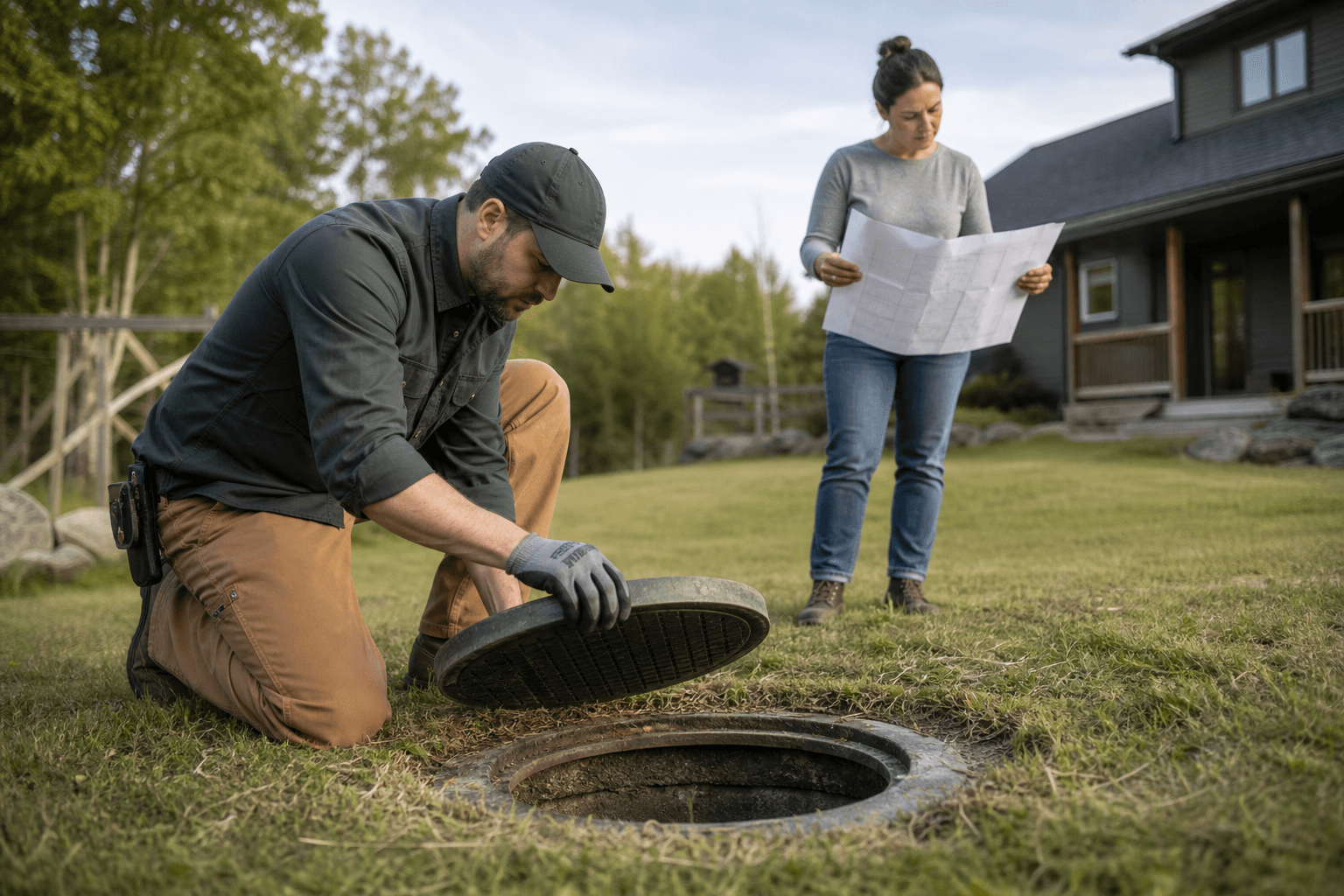
A general home inspection, a septic system inspection, and a sewer camera assessment answer different questions. If a property uses a private septic system, a standard home inspection may review accessible plumbing and related areas without confirming that the tank, distribution system, or treatment area is functioning properly.
The right choice depends on how wastewater leaves the property, the available records, visible symptoms, and your timeline. In many cases, a general home inspection should be combined with a septic specialist’s assessment. A sewer camera assessment may also be appropriate, but it examines the buried drain line rather than the septic tank or absorption area.
Home inspection, septic inspection, and sewer camera assessment compared
These assessments are not interchangeable. The table shows the practical difference between them and when each is most useful.
| Assessment | Primary question | Typical focus | Best fit | Main limitation |
|---|---|---|---|---|
| General home inspection | What is the visible and accessible condition of the building? | Structure, roof, exterior, plumbing, electrical, heating, cooling, insulation, and interior components within the agreed scope | Buying, selling, maintaining, or documenting the overall property | It does not automatically prove that a private septic system performs properly or meets regulatory requirements. |
| Septic system inspection | What is the observed condition and apparent serviceability of the private wastewater system? | Tank, access points, distribution components, treatment or absorption area, maintenance history, and system documentation, according to the specialist’s scope | A septic-served property, especially before purchase or when records are incomplete | Scope, testing methods, access, and conclusions vary. Some conditions require further testing or specialist review. |
| Sewer camera assessment | Is the buried drain line clear and structurally intact? | An accessible sewer lateral or other buried pipe, using a camera to document blockages, cracks, roots, offsets, or related defects | Recurring backups, slow drainage, suspected line damage, or uncertainty about the connection | It does not inspect the septic tank, treatment field, or whole home. |
ASM’s documented residential scope covers accessible building systems and components, with photographs, system-by-system findings, stated limitations, and same-day PDF reporting. Its sewer system inspection information describes a separate video-camera assessment of buried drain lines.
What a general home inspection can and cannot tell you

A residential home inspection helps buyers, sellers, owners, and investors understand the condition of accessible building components. Depending on the agreed scope and site conditions, this may include the structure, roof, attic, exterior, basement, plumbing, electrical, heating, cooling, insulation, walls, floors, ceilings, doors, windows, and other visible components.
The inspection may identify related observations such as damp areas, plumbing symptoms, exposed access covers, poor grading, or visible discharge concerns. However, a clean basement or functioning fixture does not establish that a septic tank is watertight, a pump operates correctly, or an absorption area can accept wastewater.
Ask whether the tank was located or opened, whether components were accessible, whether the treatment area was evaluated, and whether a septic specialist was recommended. A general report should not be treated as a certificate of septic performance or compliance.
What a septic system inspection is meant to evaluate
A septic system inspection is a focused assessment of private wastewater infrastructure. The exact scope should be confirmed in writing, but it may address the tank, inlet and outlet conditions, baffles or related components, pumping history, distribution equipment, treatment or absorption area, visible evidence of failure, and available property records.
Access is central. The specialist may need the tank location, exposed or uncovered access points, recent pumping information, and a clear understanding of drainage areas. If the system layout is unknown, locating the tank or field may be a separate task rather than an assumed part of every inspection.
Ontario explains that septic maintenance can help save money and protect water quality. Its source-protection guidance also says inspection programs can identify systems that are poorly maintained or not functioning properly and may pose risks to drinking water. That context supports careful investigation, but it does not determine the condition of a particular property. Review Ontario’s septic system information and obtain property-specific advice from the appropriate qualified professional.
When the problem may be in the sewer line instead
Some properties use municipal sewer service rather than a private septic system. Others have a private septic system but still contain buried building drain lines that can develop separate problems. A sewer camera assessment examines that pipe route, not the septic tank or treatment field.
A camera can document the interior of an accessible line and show roots, cracks, blockages, offsets, or low sections. It is often the more relevant investigation when the concern is a recurring backup, widespread slow drainage, or uncertainty about the line between the building and its connection point.
Confirm who will perform the assessment, how much of the line can be reached, whether the recording includes depth and location, and whether the report recommends further investigation.
Which assessment fits the property’s situation?
The following situations are reasons to investigate further, not diagnoses. A symptom can originate in a fixture, building drain, buried lateral, septic tank, distribution system, treatment area, or another component.
- You are buying a septic-served property. Arrange a general home inspection for the building and ask whether a separate septic assessment is needed before removing conditions or finalizing the purchase.
- The system’s history is unclear. Missing permits, an unknown tank location, no pumping records, or incomplete seller disclosures increase the value of confirming the system’s scope and history with a specialist.
- Fixtures drain slowly or backups recur. These are plumbing inspection red flags that may justify a septic review, sewer camera assessment, or both, depending on the waste connection.
- There are unusual odours, wet areas, or unusually lush vegetation. Document the location and timing, then request specialist advice. Do not infer from one visual sign that the tank or treatment field has failed.
- The tank or access points cannot be found. Ask whether locating, uncovering, pumping, or exposing components is included. Do not assume an inaccessible component was evaluated.
- The property is connected to municipal sewer. A septic inspection may not be relevant, while a sewer lateral camera assessment could be useful if drainage symptoms or line concerns exist.
What to gather before booking a septic-related assessment
Preparation helps the specialist assess the right system and prevents avoidable access limitations. Gather:
- Confirmation of whether the property uses septic, municipal sewer, or another arrangement.
- Permits, site plans, installation documents, inspection records, and repair or replacement information.
- Pumping dates, service invoices, maintenance history, and previous contractor details.
- Suspected tank, cleanout, distribution, and treatment-area locations, including site sketches.
- Seller disclosures and details about backups, slow fixtures, odours, wet ground, alarms, or unusual wastewater behaviour.
- The closing date or maintenance deadline.
Before paying for an assessment, ask which components are included, what access is required, what tests will be performed, which areas are excluded, how the report will be delivered, and whether photographs or video are provided. Also ask whether pumping, locating, repairs, regulatory review, or laboratory testing are separate services.
How to read the findings without overinterpreting them
A useful report separates observations from conclusions. Look for the condition observed, supporting evidence, location, inaccessible areas, limitations, recommended next step, and whether a qualified trade or specialist should review the issue.
Keep the reports distinct. A general home inspection may document a wet basement or plumbing symptom. A septic report may address the tank and treatment system. A sewer camera report may show a defect in the buried lateral. One report cannot silently fill the gaps in another.
No visual or specialist assessment guarantees that a system will not fail later. If a report identifies uncertainty, obtain recommended follow-up before purchasing, waiving an inspection condition, approving repairs, or relying on the system for long-term occupancy.
Why maintenance and water-quality context matters in Ontario
Septic systems affect more than a property owner’s repair budget. Ontario links proper septic maintenance with protecting water quality, and its guidance notes that poorly functioning or poorly maintained systems may create risks to drinking water in relevant circumstances.
Ontario Regulation 315/10 includes requirements for maintenance inspection programs covering certain sewage systems. That does not mean every private property has the same inspection obligation or that a general report determines compliance. For a legal, regulatory, environmental, or water-quality question, verify applicable local requirements with the responsible authority or a qualified professional.
A practical decision path before purchase or maintenance
- Identify the waste system. Confirm whether the property is septic-served or connected to municipal sewer.
- Gather records and symptoms. Collect permits, pumping history, plans, invoices, disclosures, and dates of drainage problems.
- Arrange the general home inspection. Use it to evaluate the accessible building and document related observations and limitations.
- Add the focused assessment. Book a septic specialist for private wastewater concerns, or a sewer camera assessment for buried-line concerns. Arrange both when separate systems or unresolved uncertainty justify it.
- Compare the reports. Check which components were accessed, what remains unknown, and whether further testing or licensed trade review is recommended.
- Decide using documented evidence. Price repairs, negotiate conditions, plan maintenance, or reconsider the property only after material uncertainties are addressed.
Frequently asked questions
Does a general home inspection include the septic tank and leach field?
Not automatically. A general inspection may document visible plumbing, moisture, grading, access covers, or related observations, but the tank and treatment area require a confirmed septic-specific scope.
Should I arrange both a home inspection and a septic inspection before buying?
Often, yes, when the property uses a private septic system. The general inspection evaluates the home, while a septic specialist evaluates wastewater infrastructure. The need for both depends on the property, records, access, symptoms, and purchase conditions.
When should a sewer camera assessment be added?
Consider one for recurring backups, widespread slow drainage, suspected roots or cracks, or uncertainty about the buried line. It does not evaluate the tank or treatment field.
What records should a buyer request for a septic-served property in Ontario?
Request permits, site plans, installation or repair records, pumping invoices, maintenance history, inspection reports, and information about the tank and treatment area. Missing records are a reason to clarify the system and arrange the appropriate specialist assessment.
Do recurring backups or slow drains prove that a septic system has failed?
No. They indicate that further investigation may be appropriate. The cause could be a fixture, building drain, buried lateral, tank, distribution component, or treatment area.
Conclusion: Match the inspection to the waste system
A general home inspection, septic system inspection, and sewer camera assessment produce different evidence. Start by identifying the property’s wastewater arrangement, then use the assessment that matches the actual decision and uncertainty.
For documented residential inspections across Toronto and the GTA, including accessible building components, system-by-system findings, stated limitations, and same-day PDF reporting, contact Asmhomeinspection. Confirm separately whether the property also requires a septic specialist or sewer-line assessment.