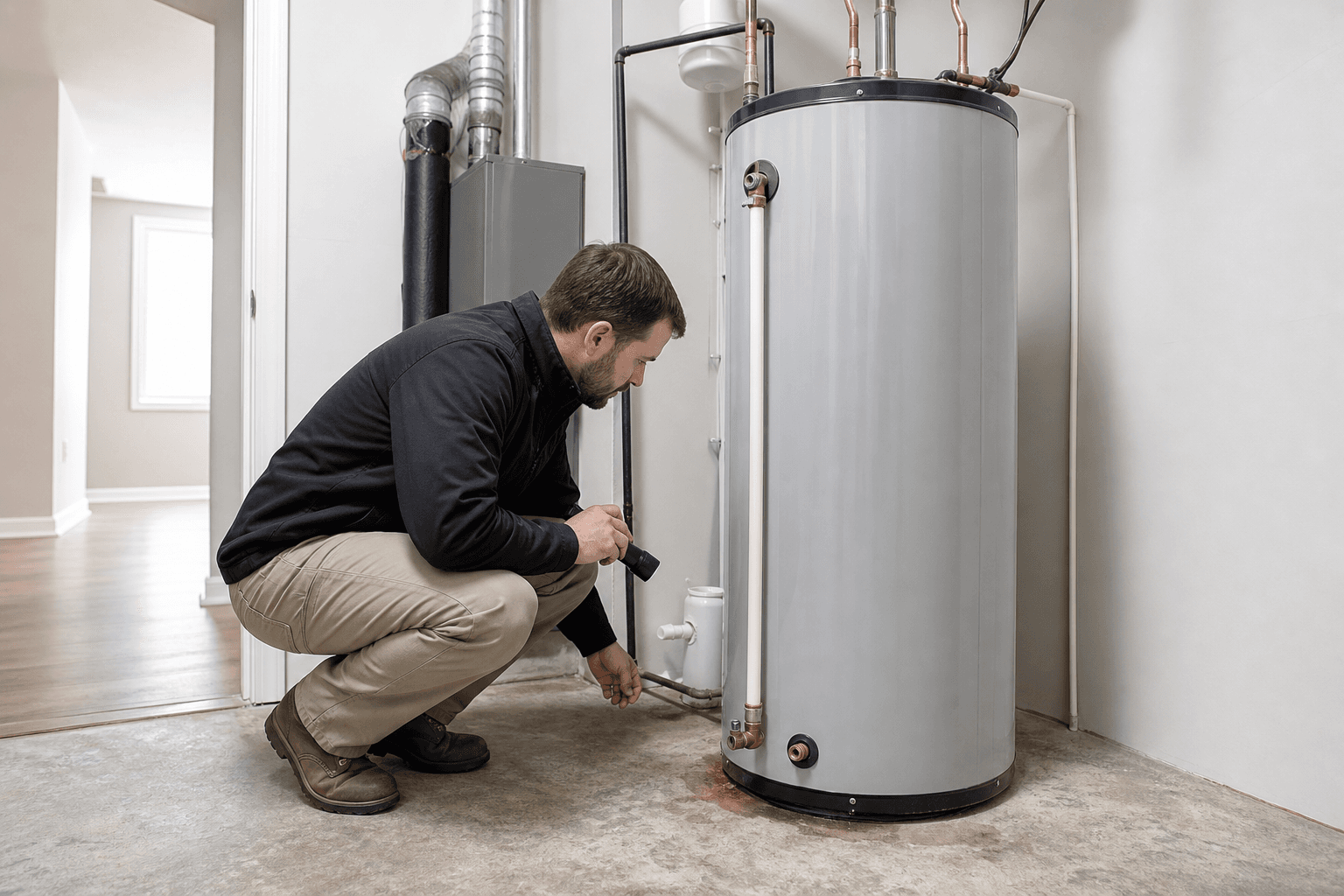
Common water heater failure signs include inconsistent or insufficient hot water, unusual noises, rusty water, moisture around the unit, low pressure, odours, heating problems, rising energy use, and repeated repairs. Active leaks, gas or combustion concerns, electrical hazards, or tank deformation require prompt qualified attention.
Start With Urgency: Which Water Heater Signs Should Not Wait?
Not every unusual sound or lukewarm shower means the tank is about to fail. Urgency depends on whether water is escaping and whether the symptom involves gas, combustion, electricity, pressure, or an unstable tank.
| Urgency | What you may observe | Next step |
|---|---|---|
| Act promptly | Active leaking, pooling, water near electrical equipment, or damage to nearby finishes. | Keep people away and arrange appropriately qualified plumbing or emergency assistance. Do not dismantle the unit. |
| Act promptly | Gas odour, smoke, scorching, exposed wiring, repeated electrical trips, or a bulging tank. | Leave an unsafe area and contact the appropriate qualified professional. Do not operate unfamiliar controls. |
| Schedule soon | Regularly lukewarm water, shorter supply, slow recovery, or recurring faults. | Record the pattern and arrange an appropriately qualified plumbing, water-heater, or electrical professional as appropriate. |
| Monitor and plan | Light surface corrosion, an isolated noise, or an older unit without an active symptom. | Photograph the condition, record the model and age, and include it in routine maintenance planning. |
ASM’s published inspection scope includes visible plumbing, water-heater condition, and observable leakage or moisture where accessible.
The Water Heater Failure Signs to Check
A water heater is not working properly when it no longer supplies water at its usual temperature and volume, or when operation is accompanied by leakage, corrosion, unusual noise, odour, or visible damage. A repeated or worsening change is more useful than one isolated symptom.
| What you notice | What it may indicate | Follow-up |
|---|---|---|
| Lukewarm or inconsistent water | A setting, thermostat, heating element, burner, control, sediment, or another system issue. | Schedule evaluation if it persists. Electric systems may need an appropriately qualified electrician or specialist; gas systems need an appropriately qualified gas-appliance or plumbing professional. |
| Hot water runs out quickly | Changed demand, slower recovery, an underperforming component, or a system that is no longer operating normally. | Record how long supply lasts and whether every fixture is affected. Arrange specialist assessment if the pattern continues. |
| Longer recovery time | A heating, control, flow, or maintenance concern. Tankless units may also respond differently to changed flow or demand. | Document timing without opening the equipment and provide the system type to the evaluator. |
| Popping, rumbling, banging, or hissing | Sediment, heating stress, expansion, trapped air, a relief or flow issue, or another condition. | Record an occasional sound for routine review. Persistent noise with leaks, overheating, or pressure symptoms deserves prompt attention. |
| Rusty, cloudy, or discoloured hot water | Corrosion, supply piping, the tank, or another plumbing condition. | Note which fixtures are affected and arrange plumbing evaluation if the problem continues. |
| Moisture, drips, or pooling | A connection, valve, drain, relief piping, tank seam, nearby plumbing, or condensation. | Active or expanding water needs prompt qualified attention. Photograph the source without approaching the unit. |
| Reduced hot-water pressure | A fixture, mixing valve, supply restriction, sediment, plumbing issue, or equipment-specific condition. | Compare hot and cold flow at several fixtures. Arrange plumbing evaluation if the reduction is widespread. |
| Unusual odour | A sulphur-like hot-water smell, burning odour, and gas odour have different causes and urgency. | Gas or burning odours require immediate caution and qualified help. Persistent hot-water odour warrants evaluation. |
| Pilot or ignition problems | An ignition, control, fuel, airflow, or venting concern on a gas unit. | Do not repeatedly relight or alter gas controls. Use an appropriately qualified professional. |
| Heating-element or electrical symptoms | Inconsistent heating, breaker trips, buzzing, scorching, or visible wiring concerns. | Do not remove covers or test internal wiring. Contact an appropriately qualified electrician or specialist. |
| Rising energy use | Changed usage, weather, household demand, settings, age, or declining performance. | Compare bills with occupancy and usage. A performance change plus another symptom supports evaluation. |
| Repeated repairs | Recurring component problems, corrosion, poor access, age-related deterioration, or an unsuitable system. | Gather repair records and request a repair-versus-replacement assessment. |
| Bulging, swelling, or severe corrosion | A serious equipment condition, although visual evidence cannot establish the internal cause. | Keep people away and arrange prompt qualified evaluation. Do not strike, drain, move, or open the unit. |
Routine review can identify water-heater condition, visible leaks, corrosion, shutoff access, and moisture before a small observation becomes a larger property problem. An annual maintenance inspection can assess those observations alongside other accessible systems.
What to Do If the Water Heater Is Leaking

A leaking water heater needs a safe response, not an attempt to tighten or open whatever looks accessible. Protect people from hot water, gas, electricity, slippery flooring, and unstable equipment before investigating the source.
- Keep clear of hazards. Do not step into pooled water near electrical equipment. Keep children and pets away, and leave if you smell gas or see smoke.
- Observe from a protected position. Note whether water appears at a connection, valve, drain, relief discharge, tank seam, floor, pan, or nearby plumbing.
- Protect belongings only if safe. Move stored items away and use towels or a container only when doing so does not expose you to heat, electricity, gas, or unstable equipment.
- Call the right professional. An active plumbing leak warrants prompt assessment by an appropriately qualified plumbing or water-heater professional. Gas or electrical symptoms may also require an appropriately qualified gas-appliance professional or electrician.
- Document the damage. Photograph the unit, floor, nearby walls, labels, and visible water path without removing covers.
Do not open electrical panels, alter gas controls, relight equipment, disconnect wiring, loosen pressure components, or attempt to repair a tank. If water damage has spread, water-damage decisions should follow an assessment of the source and affected materials, not the stain alone.
Tank, Tankless, Gas, and Electric Systems Do Not Fail the Same Way
The same symptom can require different follow-up depending on whether the property has a storage tank or tankless unit, and whether it uses gas or electricity. Record the model if it is safely accessible, but do not remove covers or rely on a generic diagnosis.
| System | Possible clues | Follow-up |
|---|---|---|
| Storage tank | Tank-body corrosion, base moisture, changing recovery time, unusual noise, or relief-pipe observations. | An appropriately qualified plumbing or water-heater professional can assess connections, controls, tank condition, and repair practicality. |
| Tankless | Temperature changes during flow, reduced performance at higher demand, error indications, flow-related shutdowns, or restricted inlets. | Use a specialist familiar with the equipment. Flow, filtration, venting, controls, and maintenance may matter. |
| Gas-fired | Pilot or ignition difficulty, combustion or venting concerns, gas odour, soot, or burning smell. | Do not relight or adjust an unclear fault. Gas and combustion concerns require appropriately qualified evaluation. |
| Electric | Inconsistent heating, breaker trips, buzzing, scorching, or exposed wiring. | Do not open access covers or test wiring. Contact an appropriately qualified electrician or specialist. |
A model name does not establish a failure pattern. Rheem Marathon concerns require the specific model, installation context, symptom, age, and visible condition. An appropriately qualified evaluation is more useful than assuming every unit of the same brand has the same problem.
What a Home Inspection Can Document
A visual home inspection can document the accessible water heater and its surroundings, including the tank or cabinet, visible connections, shutoff access, discharge piping, corrosion, floor or drain-pan moisture, nearby damage, accessible plumbing, labels, and observable operation where conditions allow.
For buyers, the water heater forms part of the visible plumbing review. The inspector may note exposed leaks, water-pressure indicators, fixture operation, apparent equipment condition, and moisture clues where accessible, as described in this inspection before closing guidance.
A general inspection cannot confirm concealed corrosion, internal tank failure, combustion performance, carbon-monoxide levels, pressure performance, code compliance, remaining service life, or the exact repair required. It does not replace an appropriately qualified plumber, electrician, gas professional, HVAC technician, or manufacturer-authorized specialist when diagnosis or repair is needed.
Repair or Replace? Use the Symptom, Not the Age Alone
Age is context, not a guaranteed replacement threshold. Consider the problem’s location, recurrence, maintenance history, equipment type, access, parts availability, and whether the unit still meets household needs.
If the issue appears localized
A single connection, valve, control, or service-related symptom may support repair when the tank shows no active deterioration and has otherwise performed consistently. An appropriately qualified specialist should confirm the source before work begins.
If water is coming from the tank body
Water at a tank seam or body creates a different planning problem from moisture at a replaceable connection. Do not identify the source from a wet floor alone. Prompt assessment can distinguish a connection issue from a condition that makes replacement more sensible.
If symptoms keep returning
Repeated repairs, recurring loss of hot water, growing corrosion, longer recovery, and rising operating concerns can make continued repair less predictable. Gather the history and request both the immediate fix and longer-term planning advice.
If the unit is old but still operating
An older unit without a leak or safety symptom is not automatically an emergency. Record its model, date if known, maintenance history, corrosion, access, and moisture so you can plan instead of waiting for failure.
Use the report as an action document: separate active leaks from maintenance observations, attach photographs to quote requests, and ask what is confirmed versus suspected. Guidance on water-heater observations helps distinguish condition, risk, priority, evidence, and next steps.
Why Water Heater Repair Costs Cannot Be Reduced to One Average
There is no reliable universal repair price. A quote changes with the failed component, fuel type, tank or tankless design, access, venting or electrical requirements, leak location, labour, replacement scope, and surrounding water damage.
When requesting an estimate, provide the make, model, fuel and system type, approximate age, exact symptom, start date, hot-water availability at each fixture, water location, photographs, repair and maintenance records, error codes, breaker trips, access limitations, condo rules, and installation constraints.
This information helps separate a service call from a replacement assessment. An inspector documents visible evidence, while the repairing professional determines technical scope and price.
How Homeowners, Buyers, Sellers, and Landlords Should Use the Finding
Homeowners and property managers
Record the model, serial information if safely visible, installation date, maintenance history, symptoms, photographs, and moisture. Compare changes over time and schedule evaluation when performance declines.
Buyers
Ask whether the water heater was accessible and whether the report describes a leak, corrosion, age-related concern, moisture, or unusual operation. If the finding affects your decision, request a specialist evaluation or replacement quote before making a decision on the property.
Use the finding to plan questions, not to assign an unsupported dollar amount. A buyer may seek a repair, credit, price adjustment, or maintenance plan depending on the confirmed condition and agreement.
Sellers and landlords
Document conditions before listing or turnover, retain repair records, and address active leaks or safety concerns promptly. Keep inspection documentation and seek appropriate specialist advice for any disclosure or repair questions.
Established GTA properties may contain older components replaced piecemeal. In older Thornhill properties, visible renovations should not be treated as proof that the water heater was replaced. The useful question is what the equipment and connections show today.
Questions Readers Still Ask About Water Heater Failure
How do I tell if my water heater is not working?
Check whether hot water reaches fixtures, reaches its usual temperature, lasts as long as expected, and recovers normally. Also look for leaks, corrosion, noise, odours, breaker trips, and ignition problems. These signs warrant evaluation but do not identify the failed component.
What should I do if my water heater is leaking?
Keep away from hot water, pooled water near electrical equipment, gas odours, smoke, and unstable equipment. Photograph the source without approaching the unit and contact an appropriately qualified plumbing or water-heater professional. Do not open panels, alter gas controls, relight the unit, or attempt repairs.
When is a leaking water heater an emergency?
Act urgently when water is spreading, reaching electrical equipment, damaging floors or walls, coming from the tank body, or occurring with gas odour, smoke, scorching, exposed wiring, pressure concerns, or deformation. Leave an unsafe area and use emergency assistance when required.
What is the average cost to fix a water heater?
A single average is misleading. Component, system type, fuel, access, labour, venting, electrical requirements, leak location, replacement scope, and water damage all affect the quote. Provide the model, symptom history, photographs, records, and access details.
What are common problems with Rheem Marathon water heaters?
There is no safe generic defect list that diagnoses every Rheem Marathon. Record the symptom, model, visible condition, leak location, performance change, and maintenance history, then have an appropriately qualified professional assess it. A general inspection documents accessible observations but cannot confirm internal failure.
Choose the Next Assessment That Matches the Problem
Use an appropriately qualified plumbing or water-heater professional for leaks and equipment diagnosis, an appropriately qualified electrician for electrical concerns, and an appropriately qualified gas or combustion professional for gas, pilot, or venting issues. Choose a general property inspection when you need the water heater documented alongside accessible plumbing, moisture, structure, roof, electrical, HVAC, and other major systems.
ASM’s website says it provides photo-rich PDF reports delivered the same day and observes accessible water-heater and plumbing conditions. Arrange a residential home inspection when you need the wider property context.