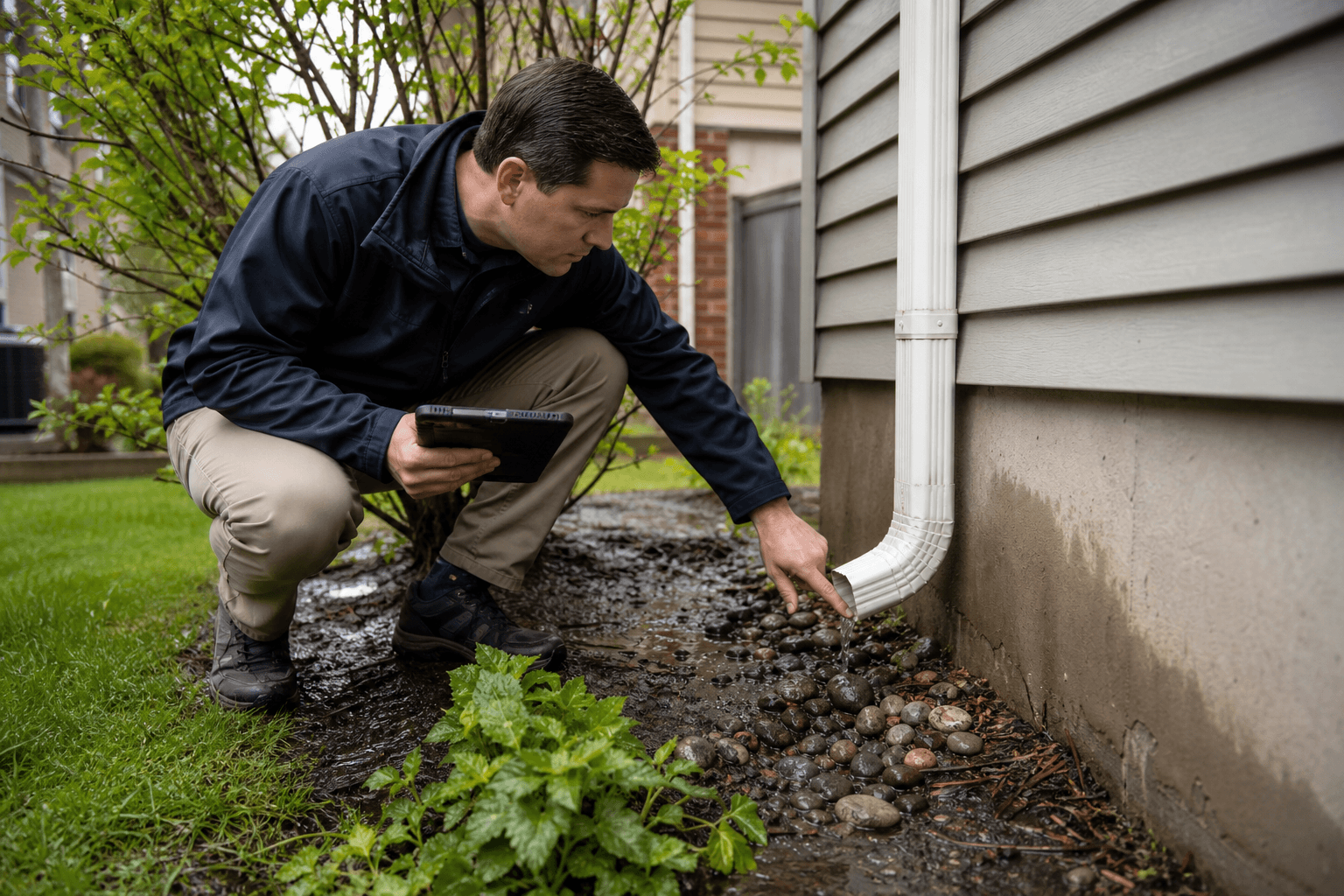
A gutter drainage inspection follows the visible path of rainwater from the roof to the ground around your home. It checks gutters or eavestroughs, downspouts or rainwater leaders, discharge points, grading, ponding, erosion, and visible signs of moisture near the foundation.
The goal is to identify conditions that may direct water toward the building, not to guarantee the performance of underground drains or concealed components. If the issue is accessible and obvious, routine maintenance may be enough. If concerns recur, affect a purchase or sale, or appear connected to basement moisture, arrange a documented residential inspection.
Quick summary

- Follow the complete water path: roof, gutters, downspouts, discharge points, grading, and foundation-adjacent areas.
- Look for overflow marks, loose components, standing water, erosion, settlement, and interior moisture evidence.
- A visual inspection documents accessible conditions. It does not prove that an underground drain is clear.
- Use routine maintenance for simple issues, a home inspection for broader documentation, and a specialist for persistent, concealed, or potentially structural problems.
Contents
- What a gutter drainage inspection covers
- Gutter drainage inspection checklist
- What can be checked visually
- Warning signs that should not wait
- When to call a specialist
- Choosing the right inspection
- Seasonal GTA checklist
- How to document findings
- Frequently asked questions
What a gutter drainage inspection covers

Gutter drainage inspection is not generally a separate statutory inspection or named Ontario qualification. In practical home-inspection work, it is a focused review of accessible roof drainage and surrounding site conditions. Ontario guidance identifies drainage away from buildings, roof drainage, and major systems as relevant considerations when buying a home. The Ontario home-buying guidance describes a home inspection as a visual review of major elements and systems.
The visible chain is straightforward:
- Rain reaches the roof and flows toward the gutters or eavestroughs.
- Gutters carry water to outlets and downspouts, also called rainwater leaders in some Ontario documents.
- Downspouts direct water to a discharge point away from the building.
- Ground surfaces and grading should not create a visible path back toward the foundation.
- Basement walls, floors, and finishes may provide additional evidence if moisture has entered or persisted.
Ontario maintenance standards address grading, ponding, erosion, water entering buildings, and the proper function of gutters and rainwater leaders. These requirements do not mean every visible defect has the same cause or urgency. Document observations carefully rather than treating them as a definitive diagnosis.
Gutter drainage inspection checklist
Review the drainage path from a safe position at ground level. Do not climb onto a roof or unstable ladder to complete a checklist. A professional can assess inaccessible areas and record conditions that are unsafe or difficult to reach.
Gutters and eavestroughs
- Look for leaves, sediment, ice damage, or other debris that could restrict flow.
- Check for sagging sections, separated joints, damaged outlets, or areas that appear to hold water.
- Look for staining, splash marks, or deteriorated materials below the gutter edge that may indicate overflow.
- Observe whether water appears to move toward an outlet rather than spill over the front or back edge.
- Check fascia, soffit, exterior walls, and nearby trim for staining or deterioration.
These observations do not require opening a wall or dismantling the gutter system. If the gutter is inaccessible, heavily damaged, or connected to a roof problem, record the limitation and arrange suitable follow-up.
Downspouts and rainwater leaders
- Look for loose connections, crushed sections, open seams, or visible blockages.
- Check whether the outlet sends water toward the foundation, a walkway, a neighbouring property, or an area that regularly ponds.
- Look for extensions, splash blocks, or other visible arrangements that carry water away from the building.
- Inspect soil near the discharge point for washout, exposed roots, settlement, or a recurring channel.
- Note whether water collects beside a basement wall or window well.
Municipal rules can vary by location and property arrangement. Do not assume that a particular extension, connection, or discharge method meets local requirements without checking the current rule for the property’s municipality.
Grading, ponding, and erosion
Stand back and observe how the ground is shaped around the building and below each discharge point. Look for settled soil, low areas, standing water after rain, saturated ground, erosion channels, or a visible slope toward the foundation. These conditions can increase moisture exposure, but they do not by themselves establish that the foundation is damaged.
Also check walkways, driveways, patios, and window-well areas. Cracks, settlement, or an edge that directs water toward the house can change the drainage path even when gutters and downspouts appear intact.
Foundation and basement evidence
Inside the property, look for dampness, staining, peeling finishes, musty conditions, efflorescence, or visible seepage marks near exterior walls and window wells. Compare the location with the exterior drainage path. A recurring pattern beside a downspout or low area is useful evidence, but one observation does not prove the moisture source.
ASM’s residential inspection scope includes accessible roofing, exterior, structure, plumbing, heating, cooling, insulation, and interior components. A broader inspection is useful when drainage is part of a larger concern rather than an isolated cleaning issue.
What can be checked visually, and what needs more investigation?
| Condition | Visual inspection can document | Limitation | Likely next step |
|---|---|---|---|
| Gutters | Debris, sagging, separation, damage, staining, and overflow evidence | It may not confirm concealed blockage or every leak | Safe cleaning or roofer follow-up |
| Downspouts | Connections, visible damage, discharge direction, extensions, and erosion marks | It cannot confirm the condition of buried sections | Correct accessible issues or consult a drainage contractor |
| Grading | Settlement, ponding, erosion, saturated soil, and visible flow toward the building | Conditions can change with weather | Maintenance, drainage assessment, or broader inspection |
| Foundation moisture | Staining, damp finishes, seepage evidence, and location | It does not prove the entry point or cause | Moisture investigation or specialist assessment |
| Underground drains | Surface symptoms, access points, and observable discharge behaviour | It does not test the entire buried system | Drainage contractor or plumber |
Ontario’s Home Inspection Act describes home inspection as a non-invasive evaluation performed according to the contract. Confirm the agreed scope before assuming that a particular drainage test or specialist service is included.
Warning signs that should not wait
Arrange prompt follow-up when you see repeated gutter overflow, a downspout discharging directly beside the foundation, persistent ponding, rapid erosion, or a drainage pattern that worsens after heavy rain. Basement moisture, recurring seepage, or staining that returns after cleaning deserves more than a one-time surface check.
Also act promptly when roof drainage components are detached, crushed, severely corroded, or connected to visible roof-edge damage. If the issue involves structural movement, extensive settlement, or a foundation crack with concerning moisture evidence, do not treat it as a simple gutter repair.
When to call a specialist
- Routine maintenance: Use safe cleaning or a qualified maintenance provider for accessible debris and minor upkeep.
- Residential home inspector: Choose a broader inspection when buying, selling, taking possession, documenting a rental, or investigating several systems.
- Roofer: Call a roofing professional for flashing, roof coverings, roof-edge damage, or roof-connected drainage concerns.
- Drainage contractor: Seek drainage expertise for persistent ponding, recurring surface flow, buried downspout questions, or suspected underground blockage.
- Plumber: Ask a plumber to assess connected plumbing or drainage components beyond exterior rainwater management.
- Engineer: Consider engineering advice when there are signs of possible structural movement.
Choose the right inspection for your situation
Homeowners
Review drainage before and after seasonal changes and after major rainfall. If the same moisture pattern keeps returning, combine a drainage review with an annual home maintenance inspection so roof, exterior, foundation-adjacent areas, and interior evidence can be considered together.
Buyers
Request a drainage review as part of a pre-purchase inspection when you see ponding, erosion, basement staining, damaged eavestroughs, or uncertain discharge arrangements. Ask what was accessible, what was observed, and which findings require specialist confirmation.
Sellers
A pre-listing inspection can reveal visible drainage issues before they become a surprise during negotiations. Correct straightforward maintenance where appropriate and retain contractor notes, without presenting a visual observation as proof that hidden drainage systems are clear.
Landlords and property managers
Document gutters, downspouts, discharge points, grading, and visible basement areas at move-in and during planned maintenance. This creates a clearer record and helps prioritize recurring moisture concerns.
Seasonal GTA gutter and drainage checklist
- Before heavy leaf fall: Check accessible gutters, outlets, downspout connections, and extensions.
- After winter and freeze-thaw conditions: Look for separated joints, crushed downspouts, settlement, erosion, or changes around window wells.
- After major rainfall: Observe overflow, discharge direction, ponding, saturated soil, and new basement moisture evidence from safe locations.
- Before listing or taking possession: Photograph the drainage path and request a broader inspection if moisture concerns remain unresolved.
Compare the same locations over time. Note whether a condition is new, worsening, or unchanged rather than relying on a single visit.
How to document drainage findings clearly
For each observation, record the location, component, visible condition, date, recent weather, photograph, recurrence, and suggested next step. For example: “Rear-left downspout, loose lower connection, soil erosion below outlet, photographed after rainfall, contractor review recommended.” This is more useful than writing only “drainage problem.”
Organize findings by urgency: active water concern, near-term repair, and routine maintenance. Clear home inspection reports can organize photos and observations by system, including gutters, grading, discharge points, and drainage patterns. ASM provides same-day PDF reporting for its inspection services, subject to the agreed scope.
Frequently asked questions
Does a standard home inspection check gutters and downspouts?
It can include accessible gutters, downspouts, grading, discharge points, and visible drainage patterns when those items are within the agreed scope. It generally cannot confirm that concealed or underground sections are clear.
Should downspouts discharge away from the foundation?
As a general drainage principle, water should be directed away from the building rather than collected beside the foundation. The correct arrangement can depend on the property and local requirements.
When should I call a drainage contractor instead of a home inspector?
Call a drainage contractor when ponding, erosion, or moisture continues after accessible gutters and downspouts have been corrected, or when you suspect a buried drain problem. Use a home inspector when you need broader documentation.
Can a gutter drainage inspection find an underground drain blockage?
Not reliably. A visual inspection may document surface symptoms or discharge behaviour, but confirming an underground blockage usually requires specialist testing.
Should buyers request a drainage review during a pre-purchase inspection?
Yes, particularly when there is ponding, erosion, basement staining, damaged roof drainage, or uncertainty about discharge. Ask the inspector to identify which questions need specialist investigation.
Conclusion: Follow the water path before choosing the next step
A useful gutter drainage inspection follows water from the roof through the eavestroughs, downspouts, discharge points, grading, and foundation-adjacent areas. Start with visible evidence, document what you find, and separate straightforward maintenance from conditions requiring a broader inspection or specialist assessment.
For GTA homeowners, buyers, sellers, landlords, and property managers, ASM provides certified residential inspections covering accessible major systems and components, with same-day PDF reporting. To discuss a property’s inspection scope, contact Asmhomeinspection.