You can perform a cautious first screening for possible deck rot, but a visual or tactile check cannot confirm structural safety or reveal all concealed deterioration. Start from the ground and other stable, accessible areas. If you find unexpected movement, sagging, extensive softness, damaged supports, or deterioration you cannot assess safely, stop and arrange a qualified professional assessment.
Before You Start: Set Safe Limits for a Homeowner Screening
Choose a dry, well-lit time and inspect only from ground level or portions of the deck that appear stable. A flashlight, phone camera, notebook, and gloves may help you observe and document conditions. Keep children, pets, and other people away while you look beneath or around the deck.
Do not climb onto a deck that visibly sags, shifts, has damaged stairs or railings, or contains areas that feel unreliable. Do not remove boards, disturb posts, dismantle connections, use power tools, or enter a confined or obstructed space to reach hidden framing. If you lightly assess an exposed, stable surface, treat any softness only as a possible indicator. Softness does not establish the full extent of rot, and firmness does not prove concealed framing is sound.
Stop point: If you cannot reach an area without unsafe access, leave it untested and record it as an access limitation.
Step 1: Start from the Ground and Look for Moisture Pathways

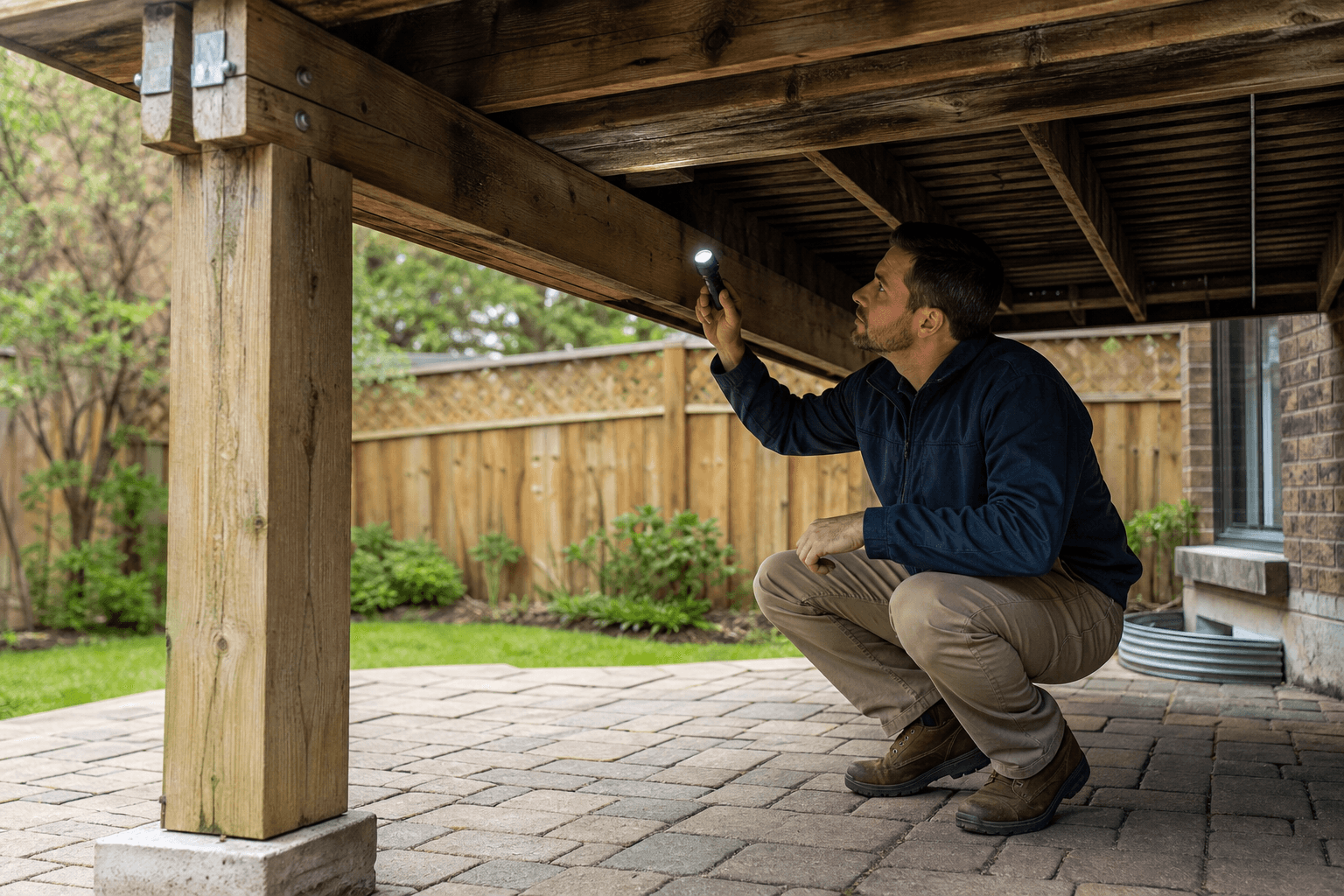
Walk around the perimeter without stepping onto questionable sections. Look underneath from a stable position where framing is visible. Pay attention to areas that appear persistently damp, stained, or poorly drained, and places where water may collect against wood or remain near supports.
Look for sagging lines, distorted framing, damaged wood, separated connections, and sections hidden behind finishes or stored items. A dark mark, crack, or stain can have several explanations, so treat it as a reason to examine the area more closely rather than proof of rot.
Stop point: Do not crawl under the deck or reach into an unstable area. Stop if the deck moves, appears to be losing support, or has framing you cannot observe safely.
Step 2: Check Deck Boards for Possible Surface Deterioration
From a stable position, inspect accessible boards for changes in texture, splits, crumbling edges, exposed fasteners, staining, or damage near joints and fastener locations. Pay particular attention to places where water collects and to board ends exposed to moisture.
Do not assume every discoloured, cracked, or weathered board is rotten. Surface weathering may differ from deeper deterioration, and one damaged board does not necessarily reveal the condition of framing below it. Look for patterns and document what you can actually see.
If a stable, accessible area feels unexpectedly soft under light contact, do not repeatedly load it with your body. A board that flexes unusually, breaks, or exposes deteriorated material is a reason to avoid that section.
Stop point: Do not walk across the deck to reach a suspected problem. If the walking surface flexes, shifts, or appears unsafe, stop using it pending professional review.
Step 3: Examine Accessible Joists, Beams, and Connections
Where framing is visible from the ground or another stable position, look at joists, beams, and connection areas for softness, splitting, staining, crumbling wood, damaged fasteners, or separation. Framing that stays damp or is shielded from view deserves particular attention because surface appearance may not show its full condition.
Compare nearby components without assuming that one sound-looking member proves the entire deck is sound. Deterioration may be localized, concealed, or more advanced where framing meets another component.
Stop point: Stop and arrange professional assessment if a joist, beam, or connection feels soft, shows extensive deterioration, has unexpected movement, or cannot be reached without dismantling the deck. Do not remove a board to investigate further.
Step 4: Inspect Posts and Support Areas Without Disturbing Them
Observe visible posts, their bases, and accessible support areas for leaning, splitting, damaged wood, staining, separation, or signs that the deck is no longer sitting as expected. Look at the relationship between the post and supported framing without digging around it or attempting to shift it.
Moisture concerns around a support can matter even when the visible surface appears limited. Buried, enclosed, or concealed portions cannot be assessed reliably through a quick homeowner check.
Stop point: If a post leans, a support appears damaged, the deck has settled or shifted, or you would need to expose concealed components, do not disturb the support. Keep people off the affected area and arrange a qualified assessment.
Step 5: Check Stairs, Railings, and Walking Transitions
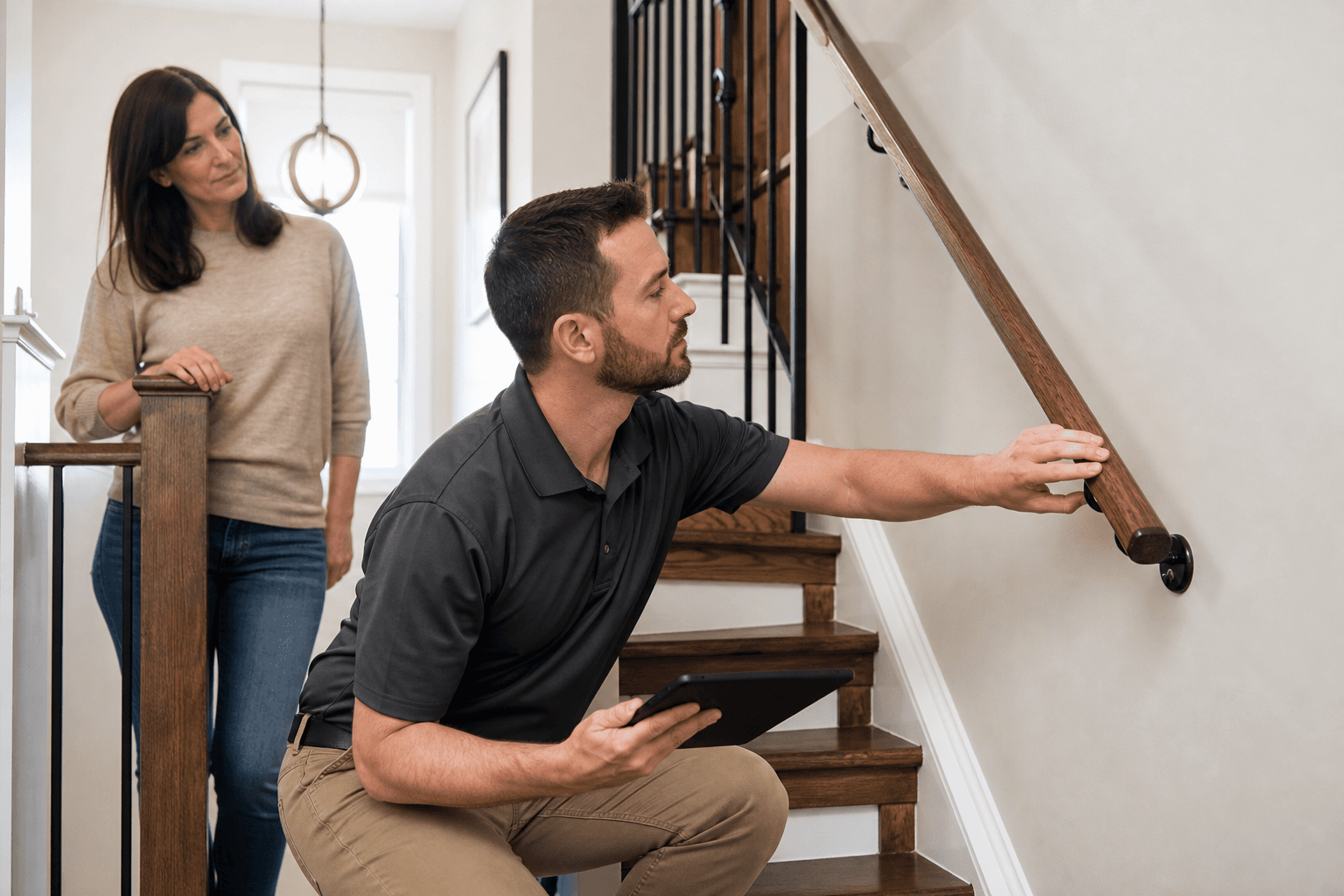
Stairs and railings deserve a separate check because deterioration or looseness can create an immediate use concern. From a stable position, look for cracked or soft-looking components, loose connections, movement, damaged edges, and railings that no longer appear firmly attached.
Do not test a questionable stair or railing by applying force or relying on it for balance. Check transitions between the deck and stairs visually before using either area. If a component moves unexpectedly, isolate it from use rather than trying to tighten or repair it during this screening.
Stop point: Avoid the stairs and deck if they shift, sag, feel soft, or have an unreliable railing or connection. A homeowner screening is not a safety certification.
Step 6: Review the Deck’s Connection to the House
From a safe, accessible position, examine where the deck meets the house. Look for staining, moisture evidence, separation, damaged wood, or deterioration along the ledger and nearby wall surface. Also note interior or exterior signs suggesting moisture may affect the adjoining area.
The house connection can contain concealed components that cannot be evaluated from outside alone. Avoid pulling away coverings, removing finishes, or probing areas that require unsafe access.
Stop point: If you see separation, significant staining, deteriorated wood, or movement at the house connection, stop using the affected area and seek professional assessment.
Step 7: Photograph and Record What You Find
Good documentation helps a contractor, inspector, seller, buyer, landlord, or property manager understand the concern. For each finding, record:
- Location: Identify the side of the deck and component involved.
- Visible symptom: Describe staining, cracking, softness, crumbling, separation, movement, or exposed fasteners without diagnosing the cause.
- Apparent extent: Note whether it seems isolated or continues across nearby components.
- Access limitation: State if framing was concealed, obstructed, too high, or unsafe to reach.
- Photographs: Take a wide view showing location and a close-up showing detail.
Keep notes factual and separate observations from suspicions. Before arranging an inspection, you may also find these questions to ask a Toronto home inspector before booking useful.
What Should You Do After the Check?
When the condition is uncertain, choose the more cautious option.
| What you observed | Reasonable next step |
|---|---|
| Minor, stable surface weathering with no movement, softness, damaged support, or concealed concern | Monitor and maintain the area. Do not treat this as confirmation that hidden framing is sound. |
| Localized deterioration, uncertain softness, staining, damaged boards, or a concern needing closer assessment | Obtain a repair or inspection assessment and provide photographs and notes. |
| Sagging, shifting, extensive softness, damaged posts or connections, unreliable stairs or railings, or suspected concealed structural deterioration | Avoid using the affected area and arrange prompt professional review. Do not attempt structural repairs yourself. |
Why Deck Concerns May Need a Broader Home Inspection
A deck is not an isolated surface. Moisture concerns and deterioration may warrant attention to nearby structural components, the foundation, basement, walls, floors, drainage-related conditions, and the connection between the deck and house.
ASM Home & Commercial Inspection states that its residential inspection scope includes porches and decks, structural and foundation components, basements, walls, floors and ceilings, plumbing, electrical systems, furnaces, water heaters, and air conditioning or HVAC components. The company also emphasizes identifying moisture intrusion early because it can contribute to structural damage and occupant safety risks.
This is a broader condition assessment, not deck repair, engineering, destructive testing, or code-compliance certification. Tell the inspector what you observed, which areas were inaccessible, and whether the deck relates to a purchase, sale, rental, or maintenance decision.
When to Arrange a GTA Residential Inspection
Consider professional assessment when buying or selling a property, when deterioration may be structural or concealed, when moisture concerns recur, or when you need documented information about the property’s condition. A pre-purchase inspection can support a buyer’s evaluation, while a pre-listing inspection can help a seller understand conditions before listing. Move-in and annual maintenance inspections may also help document condition or identify maintenance concerns.
For more preparation, review pre-purchase home inspection mistakes to avoid and the role of a GTA pre-listing inspection.
Frequently Asked Questions
Can a homeowner confirm deck rot with a screwdriver or visual inspection?
No. Visual inspection and limited tactile checks can identify possible concerns, but they cannot confirm structural safety or reveal concealed deterioration. Do not probe unstable areas or use a screwdriver as a reason to continue loading questionable components.
Which deck findings mean I should stop using the deck?
Stop using the affected area when you notice movement, sagging, extensive softness, damaged posts or connections, unreliable stairs or railings, or suspected concealed structural deterioration. Keep people away until the condition receives appropriate professional review.
Can a residential home inspection assess a deck and related moisture concerns?
A residential inspection can assess accessible deck and related property components within its stated scope. It is not a repair, engineering assessment, destructive test, or code-compliance certification, so clarify the concern and any access limitations when booking.
Conclusion: Stop at Uncertainty and Match the Response to the Risk
The safest deck rot screening starts at ground level and progresses only through stable, accessible areas. Look for possible moisture damage and deterioration in boards, framing, posts, stairs, railings, and the house connection, then record specific observations with photographs. A soft spot, stain, or crack may justify further assessment, but none of these checks can confirm structural safety or reveal every concealed problem.
ASM Home & Commercial Inspection provides certified residential inspections across the GTA, states that its scope includes decks and structural components, and provides same-day PDF inspection reports. Learn more or schedule an assessment through ASM Home & Commercial Inspection.