Before you buy, sell, rent, or continue maintaining a property, check more than whether the stair railing looks attractive. A useful stair railing safety guide should help you look for movement, weak attachment, visible damage, interrupted hand contact, and problems around the steps. These checks can reveal concerns that deserve documentation or professional assessment, but a visual review does not prove compliance with the Ontario Building Code or reveal every concealed defect.
What a Stair Railing Safety Check Can and Cannot Tell You
A visual check is a sensible first step for a homeowner, buyer, seller, landlord, tenant, or property manager. It can help identify visible conditions such as a loose handrail, damaged tread, obstructed landing, or deteriorated attachment point. It also gives you useful information to share with an inspector or contractor.
However, it is not the same as an engineering review, repair assessment, or formal code inspection. Ontario requirements can depend on the building, the work being performed, and the applicable regulation. Consult the Ontario Building Code regulation for current regulatory questions rather than using a general visual checklist to declare that a stairway complies or violates the rules.
Use the following checks to identify questions, not to assign a legal classification or guarantee that the staircase is safe.
Check Whether the Handrail or Guard Moves

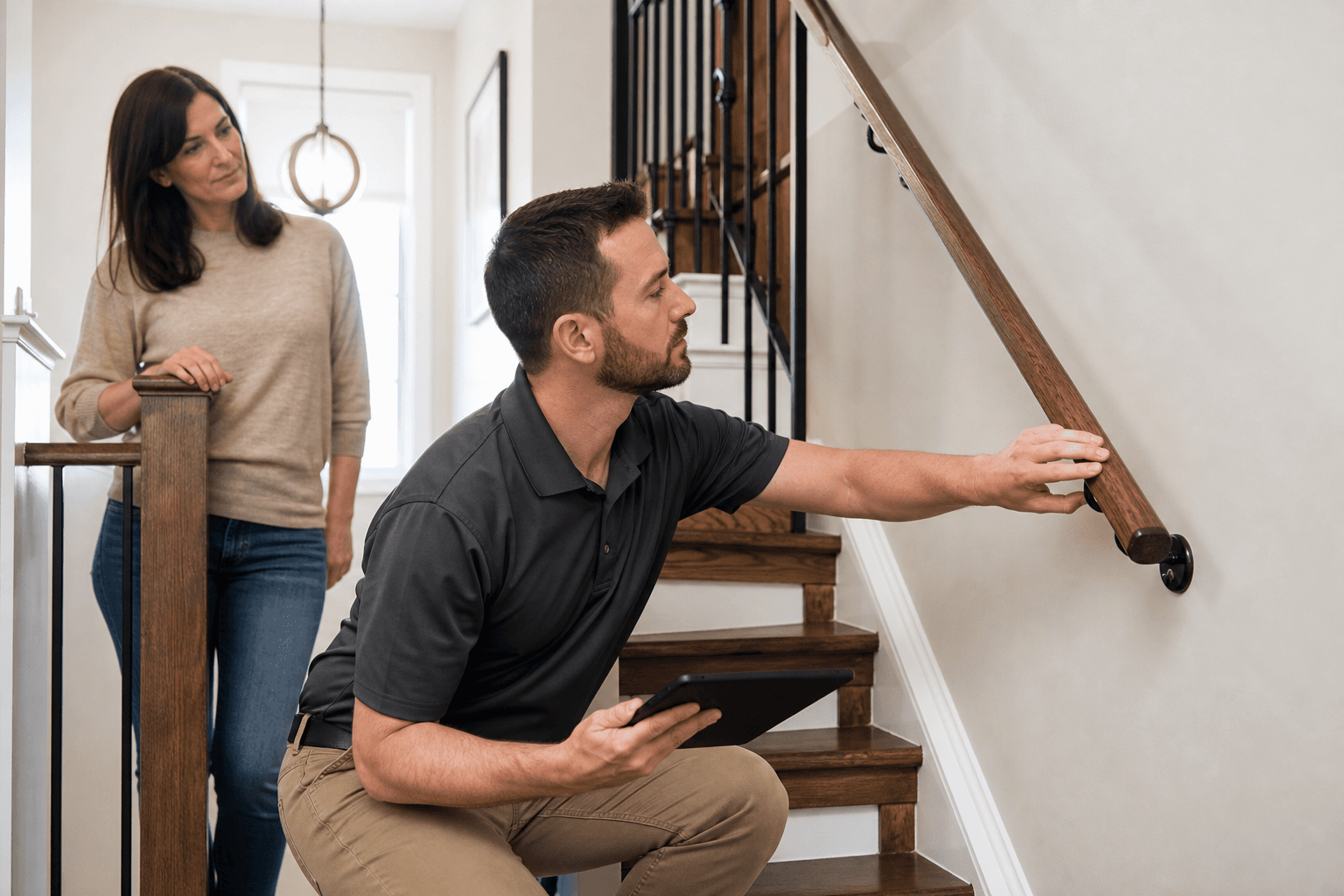
Start by looking at the entire handrail, guard, posts, brackets, and visible connection points. From a normal standing position, apply only light, controlled pressure. Unexpected rocking, shifting, rattling, or separation from the wall, floor, or stair structure is a reason to document the condition and avoid treating the railing as dependable until it has been assessed.
Pay attention to movement at more than one point. A railing may appear secure near one end but move at a bracket, post, joint, or change in direction. Look for gaps, missing hardware, visibly loose fasteners, cracked mounting areas, or connections that appear to have pulled away from their supporting surface.
Do not lean your full body weight onto a questionable railing, apply force intended to simulate an impact, remove fasteners, or open finished surfaces. If movement is significant or the attachment cannot be seen, record what you observed and arrange an appropriate assessment.
Look for Damage, Deterioration, and Sharp Projections
Inspect the rail and surrounding components for conditions that could affect use or indicate a broader maintenance issue. Relevant observations may include:
- Cracks, splits, warping, or broken sections.
- Rot, soft areas, corrosion, or deterioration near fasteners and joints.
- Exposed screws, nails, brackets, splinters, or sharp edges.
- Damaged, loose, or incomplete stair surfaces.
- Signs of staining, dampness, or moisture-related deterioration near the stairs.
The position and extent of the defect matter. A small surface blemish is different from damage at a connection, post, tread, or landing. Do not cover, sand, tighten, or paint over a concern before photographing it if the condition may matter to a transaction, warranty discussion, or inspection record.
Review Transitions, Ends, and Changes in Direction
Follow the handrail from the start of the staircase to the end. Look at points where it begins or ends, turns around a landing, changes direction, or meets another surface. Abrupt interruptions, confusing transitions, or damaged ends can make movement less predictable.
Also inspect where the staircase meets a landing, hallway, doorway, or different floor covering. Watch for raised edges, loose transitions, curled material, or sudden changes that could catch a foot. The goal is to identify conditions that deserve closer review without claiming that a particular arrangement automatically fails an Ontario requirement.
Inspect the Steps and the Space Around Them
A railing concern may be part of a wider stair-condition problem. Look for objects, cords, clutter, loose coverings, damaged treads, unusually slippery-looking surfaces, poor visibility, blocked fixtures, or doors and furniture that interfere with access. Check for water, staining, dampness, or other signs that may affect adjacent materials.
Do not walk on a visibly unstable step, climb over an obstruction, or test a damaged area in a way that could worsen it. Larger structural, moisture, electrical, or surface concerns may need to be considered alongside the rest of the property.
Do Not Rely on Appearance Alone
A polished railing can still have a weak connection behind finished material. Conversely, an older-looking handrail may have no obvious functional concern from a brief glance. Paint, trim, coverings, lighting, and viewing angles can hide important details.
If you cannot see the attachment, if the railing moves, or if the concern appears connected to moisture or structural movement, note the limitation. Do not state that the staircase is safe, unsafe, compliant, or non-compliant solely because of its appearance.
What Should You Do After Finding a Concern?
These categories are practical decision guidance, not legal classifications or guaranteed risk levels.
| What you observe | Reasonable next step |
|---|---|
| No visible damage, unexpected movement, or obstruction during a limited visual check | Observe and document the condition as part of routine maintenance. Recheck it if the staircase, nearby materials, or use of the space changes. |
| Surface wear, a minor visible defect, loose covering, poor housekeeping, or a straightforward maintenance issue | Arrange appropriate maintenance and keep photographs and notes. Do not present the repair as proof of broader code compliance. |
| Unexpected movement, damaged attachment points, significant deterioration, suspected moisture, structural movement, an inaccessible connection, or a concern affecting a property decision | Request professional assessment. Limit use of the questionable area as appropriate and provide clear observations rather than attempting an improvised repair. |
How to Document a Stair or Railing Concern
- Photograph the full staircase, landing, and surrounding area.
- Take close-ups of the railing, connection, tread, transition, or obstruction involved.
- Write the exact location, such as the upper landing, lower end, middle post, or left side of a stair flight.
- Describe what you observed without guessing at the cause. Note movement, damage, staining, or obstruction.
- Record the date and whether the condition was visible before or after a repair, renovation, move-in, or transaction.
Keep the record available for a buyer, seller, landlord, contractor, property manager, or inspector. Photographs and notes do not establish compliance, but they help others understand what prompted the question.
When Should This Be Part of a Broader Property Inspection?
Include stairs and railings in a broader residential home inspection when the property decision involves more than one visible issue or when you need context across major systems. A pre-purchase home inspection can help a buyer consider the stairs alongside the roof, attic, structure and foundation, basement, plumbing, electrical systems, HVAC, and other components.
A pre-listing inspection helps a seller understand and document conditions before listing. A new construction inspection may record concerns about workmanship or incomplete components. A move-in inspection can document a rental’s condition at the beginning of occupancy, while an annual maintenance inspection can help an owner monitor changes over time.
For related preparation, see these resources: questions to ask a home inspector in Toronto before booking, pre-purchase inspection mistakes to avoid, how a GTA pre-listing inspection works, and what a Toronto move-in inspection documents.
How Should Ontario Rules Be Used in Your Decision?
Ontario regulations are relevant when your question involves construction, workplace conditions, temporary stairs, or formal compliance. Read them in their current and applicable form. The Ontario government also provides information about temporary stairs on construction projects, which is a different context from casually checking an occupied home.
Do not infer a code violation from a loose-looking component alone, and do not assume that a general residential inspection answers every formal compliance question. For construction work, a workplace, a permit, or a legal dispute, ask the appropriate qualified professional or authority which requirements apply.
How a GTA Home Inspection Can Put the Concern in Context
ASM Home & Commercial Inspection provides certified residential and commercial property inspections across the Greater Toronto Area. Its inspection scope includes stairs and railings along with roofs, attics, structures and foundations, plumbing, electrical systems, HVAC, garages, porches, decks, walls, floors, ceilings, doors, windows, and basements.
The inspector is described as an InterNACHI certified inspector and a CCPIA certified inspector. The company offers pre-purchase, pre-listing, new construction, move-in, and annual maintenance inspections, with same-day PDF reports according to the supplied business information. These services can place a stair or railing observation within the broader condition of the property, while a repair, engineering, or compliance question may still require another qualified professional.
Questions About Stair Railing Safety Checks
Does a visual stair railing check prove that the stairs meet the Ontario Building Code?
No. A visual check can identify visible movement, damage, obstruction, or deterioration, but it does not establish formal compliance. Applicable requirements can vary by context, so consult current Ontario rules and an appropriate qualified professional when compliance is the actual question.
When should a stair or railing concern become part of a broader residential home inspection?
Consider a broader inspection when the concern affects a purchase, sale, move-in, construction decision, or maintenance plan, or when it appears connected to moisture, structural movement, or other property systems.
What should I document before asking an inspector to assess a stair or railing issue?
Provide photographs of the full staircase and specific concern, its exact location, and a factual description of what you observed. Note movement, damage, moisture indicators, or obstructions, and explain whether the property is being bought, sold, occupied, renovated, or maintained.
Make the Next Stair Railing Decision Deliberately
The most useful stair railing safety check is not a rushed search for one measurement or a judgment based on appearance. Look for movement, weak attachment, damage, deterioration, confusing transitions, obstructions, and surrounding stair conditions. Document what you find, avoid unsafe testing, and treat uncertainty as a reason to ask a qualified professional rather than as proof of compliance or failure.
ASM Home & Commercial Inspection provides certified residential and commercial inspections across the GTA, includes stairs and railings in its inspection scope, and provides same-day PDF inspection reports. Learn more or schedule an inspection through ASM Home & Commercial Inspection.